Age at lay and rates
- Coturnix may start laying at 6–8 weeks [3]. Sexual maturity is reached at about 38–42 days [10], with full production by about 50 days [1].
- Expect about 200 eggs in a hen's first year [1]. A Japanese reference gives 80–90 eggs per 100 days [10].
- Moving laying hens to new quarters usually causes a 2–3 week pause in laying [1][7].
- Keep layers where disturbances are minimal [7].
Egg size and color
- An average egg weighs about 10 g [1]. NSW puts that at about 8% of the hen's body weight [1]; UC ANR says about 10%, more than twice the ratio of most birds [2]. USDA lists one quail egg at 9 g [19].
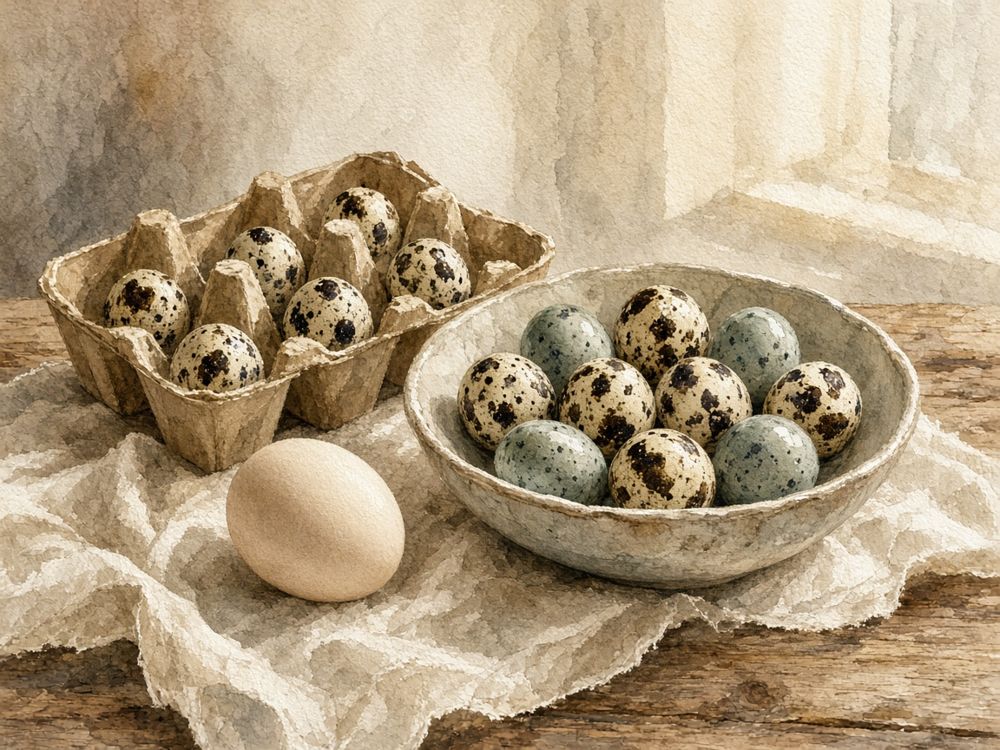
- Shells are mottled brown, often with a chalky blue coating; some strains lay only white eggs [1]. Wild quail lay white, flesh-tinted, light brown or speckled eggs [10].
Lighting
- 14–18 hours of light per day keeps production and fertility high [1][6]. In Indiana, that means supplemental light from fall through spring [1].
Handling and storage of eating eggs
The USDA guidance below was written for chicken eggs; no quail-specific federal storage guidance was found, so it is the best available standard.
- Refrigerate eggs as soon as possible after collection and keep them cold; a cold egg left out can "sweat," which helps bacteria move into the egg [21].
- Raw eggs in the shell keep 3 to 5 weeks in the refrigerator; hard-cooked eggs keep 1 week [21].
- Don't leave eggs out of the refrigerator for more than 2 hours [21].
- USDA does not recommend that consumers wash eggs, because wash water can be pulled through shell pores [21].
- Cook egg dishes to 160°F [21][22].
- Home-pickled eggs must be refrigerated and used within 7 days, and home canning of pickled eggs is not recommended [21]. (Worth knowing, since pickled quail eggs are so popular.)
Nutrition: quail egg vs. chicken egg (per 100 g, raw)
| Nutrient | Quail egg [19] | Chicken egg [20] |
|---|---|---|
| Energy | 158 kcal | 143 kcal |
| Protein | 13.05 g | 12.56 g |
| Fat | 11.09 g | 9.51 g |
| Cholesterol | 844 mg | 372 mg |
| Iron | 3.65 mg | 1.75 mg |
| Riboflavin (B2) | 0.79 mg | 0.457 mg |
| Vitamin B12 | 1.58 µg | 0.89 µg |
| Selenium | 32 µg | 30.7 µg |
| Choline | 263.4 mg | 293.8 mg |
| Vitamin A (RAE) | 156 µg | 160 µg |
Per gram, quail eggs are richer in fat, cholesterol, iron, riboflavin and B12 than chicken eggs. Because one quail egg weighs about 9 g [19], a single egg is small: about 14 kcal and 1.2 g protein (our calculation from the per-100 g values).
Sources for this page
Numbers in brackets throughout the page point to these sources. Many are university extension publications, government agencies or peer-reviewed studies.
- Randall, M. & Bolla, G. (2008). Raising Japanese quail (Primefact 602, 2nd ed.). NSW Department of Primary Industries. https://www.dpi.nsw.gov.au/__data/assets/pdf_file/0005/145346/Raising-Japanese-quail.pdf (full text also reprinted at https://www.thepoultrysite.com/articles/raising-japanese-quail-1)
- Ernst, R. A., Woodard, A. E., Vohra, P. & Cardona, C. Raising Game Birds (ANR Publication 8155). University of California Agriculture and Natural Resources. https://ucanr.edu/sites/default/files/2018-07/286690.pdf
- Mississippi State University Extension. Feeding Quail (Publication 2383). https://www.poultry.msstate.edu/pdf/extension/feeding_quail.pdf
- Varghese, S. K. Japanese Quail (Coturnix) (Extension Bulletin E-1069). Michigan State University Extension. https://sanweb.lib.msu.edu/DMC/Ag.%20Ext.%202007-Chelsie/PDF/e1069.pdf
- Texas A&M University (1974). Japanese Quail (Coturnix): Care, Management, Propagation. https://hdl.handle.net/1969.1/92988
- Mizutani, M. (2003). The Japanese Quail. In The Relationship Between Indigenous Animals and Humans in APEC Region. APEC. https://www.apec.org/docs/default-source/publications/2003/12/the-relationship-between-indigenous-animals-and-humans-in-apec-region-2003/toc/quail.pdf
- USDA FoodData Central. Egg, quail, whole, fresh, raw (FDC 172191). https://fdc.nal.usda.gov/food-details/172191/nutrients
- USDA FoodData Central. Egg, whole, raw, fresh (FDC 171287). https://fdc.nal.usda.gov/food-details/171287/nutrients
- USDA Food Safety and Inspection Service. Shell Eggs from Farm to Table. https://www.fsis.usda.gov/food-safety/safe-food-handling-and-preparation/eggs/shell-eggs-farm-table
- USDA Food Safety and Inspection Service. Safe Minimum Internal Temperature Chart. https://www.fsis.usda.gov/food-safety/safe-food-handling-and-preparation/food-safety-basics/safe-temperature-chart