
About
About Happy Quail
A small Indiana homestead sharing what we've learned about coturnix quail.
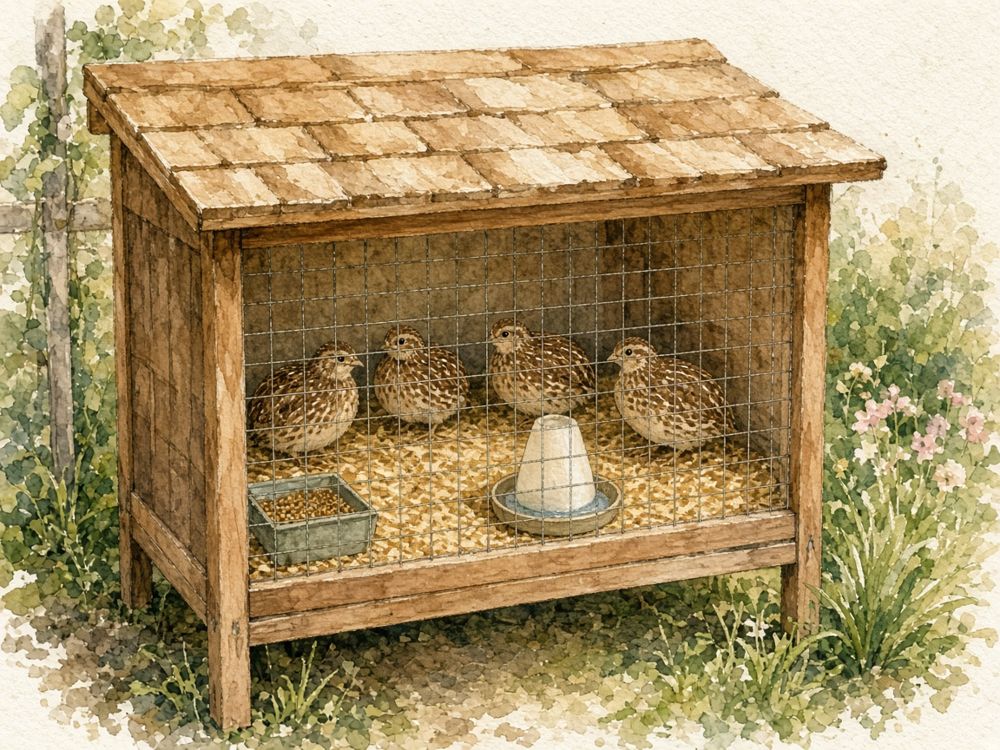
Happy Quail is run by Birdie Jane, who raises coturnix (Japanese) quail on her homestead in Indiana. This site gathers the practical know-how: how to house, feed, hatch and care for quail, and how to enjoy their eggs and meat.
How we research
Quail advice online is full of guesswork, so this guide leans on university extension services, government agencies and peer-reviewed research. Every fact carries a numbered citation, and each page lists its sources at the bottom. When good sources disagree, we say so and give the range rather than picking a winner. Where no quail-specific guidance exists and we fall back on chicken advice, we say that too.
Where the experts disagree
A few topics where published sources were thin or conflicting:
- Space per bird: a nearly tenfold range, from about 16 sq in (commercial cages) to 1 sq ft plus a run (backyard guides) [6][7][1][2][8].
- Layer protein: 18% [3] vs. 20% [2] vs. 24% [1].
- Incubation: 99.5°F vs. 100°F; lockdown on day 14 vs. day 15 [1][5][6].
- Brooder step-down: about 3.5°C per week [1] vs. 5°F per week [2].
- Egg size relative to hen: about 8% [1] vs. 10% [2] of body weight.
- Lifespan: 2–2.5 years [1] vs. average 3–4 years [10].
- History: "thousands of years" in captivity [2] vs. semi-domestication in the 1500s [10].
- Winter, summer and treat guidance: no quail-specific extension numbers found; chicken guidance used [42][43].
- Jumbo strain weights: no extension or peer-reviewed data on current US jumbo lines.
- Color variety names: mapped only by breeder sources; Italian (lethal yellow vs. viable fawn) is unresolved [14][11].
- Legal status of quail eggs and meat in Indiana after HEA 1424: state guidance has not caught up; one county reads quail eggs as exempt "produce" [32], and older state guidance says quail meat must be inspected [30]. Confirm with BOAH and your county health department.
Follow @BirdieJane on X, or get in touch.
Sources for this page
Numbers in brackets throughout the page point to these sources. Many are university extension publications, government agencies or peer-reviewed studies.
- Randall, M. & Bolla, G. (2008). Raising Japanese quail (Primefact 602, 2nd ed.). NSW Department of Primary Industries. https://www.dpi.nsw.gov.au/__data/assets/pdf_file/0005/145346/Raising-Japanese-quail.pdf (full text also reprinted at https://www.thepoultrysite.com/articles/raising-japanese-quail-1)
- Ernst, R. A., Woodard, A. E., Vohra, P. & Cardona, C. Raising Game Birds (ANR Publication 8155). University of California Agriculture and Natural Resources. https://ucanr.edu/sites/default/files/2018-07/286690.pdf
- Mississippi State University Extension. Feeding Quail (Publication 2383). https://www.poultry.msstate.edu/pdf/extension/feeding_quail.pdf
- Mississippi State University Extension. Important incubation factors. https://extension.msstate.edu/agriculture/livestock/poultry/important-incubation-factors
- Varghese, S. K. Japanese Quail (Coturnix) (Extension Bulletin E-1069). Michigan State University Extension. https://sanweb.lib.msu.edu/DMC/Ag.%20Ext.%202007-Chelsie/PDF/e1069.pdf
- Texas A&M University (1974). Japanese Quail (Coturnix): Care, Management, Propagation. https://hdl.handle.net/1969.1/92988
- Jacobs, L. & Clauer, P. J. Small-scale Poultry Housing (APSC-186). Virginia Cooperative Extension / Virginia Tech. https://www.vtdairy.dasc.vt.edu/content/dam/pubs_ext_vt_edu/2902/2902-1092/APSC-186.pdf
- Mizutani, M. (2003). The Japanese Quail. In The Relationship Between Indigenous Animals and Humans in APEC Region. APEC. https://www.apec.org/docs/default-source/publications/2003/12/the-relationship-between-indigenous-animals-and-humans-in-apec-region-2003/toc/quail.pdf
- Tsudzuki, M. (2008). Mutations of Japanese quail (Coturnix japonica) and recent advances of molecular genetics for this species. Journal of Poultry Science 45:159–179. https://www.jstage.jst.go.jp/article/jpsa/45/3/45_3_159/_article
- Southwest Gamebirds (breeder). Plumage Variations in Publicly Available Japanese Quail and their Underlying Genetics. https://southwestgamebirds.com/pages/genetics
- Indiana Department of Health. Home Based Vendors FAQ (HEA 1149). https://www.in.gov/health/food-protection/files/Home-Based-Vendors-FAQ-FINAL.pdf
- Starke County (Indiana) Health Department (Oct. 2026). Indiana Home and Small Farm Food Processors. https://starke.in.gov/wp-content/uploads/2026/10/HBV-Small-Farm-and-Homestead-Food-Vending.pdf
- Carlson, C. & Lochner, H. Caring for chickens in cold weather. University of Minnesota Extension. https://extension.umn.edu/agriculture/animals-and-livestock/poultry/caring-for-chickens-in-cold-weather
- Wright, A. Managing Backyard Chickens During Periods of Extreme Summer Temperature. University of Arizona Cooperative Extension, via Extension Poultry. https://poultry.extension.org/articles/poultry-management/managing-backyard-chickens-during-extreme-summer-temperatures/